
Giles County Court Records After Arrest
After a Giles County arrest, the first public trail may be a custody entry at New River Valley Regional Jail. That entry is a booking record, not the court case. The court record begins when charges are filed or continued in a Virginia court. General District Court handles most misdemeanors and preliminary hearings for felonies. Circuit Court handles felony prosecutions, indictments, trials, and other serious criminal matters. The practical path is arrest, magistrate or warrant processing, jail booking if release does not occur first, then a court case that lists formal charges and events.
That distinction matters because the jail and the court answer different questions. The Giles County jail inmate records page is the better route for custody status, booking clues, and the New River Valley Regional Jail lookup. The court case is the better route for filed charges, hearing dates, dispositions, and whether a charge was dismissed, amended, reduced, or convicted. Booking photos are also a separate subject, and the Giles County jail mugshots page explains the limits on official photo access.
Giles County Arrest to Court Path
Giles County arrests may involve the Sheriff's Office, town police, Virginia State Police, or another agency. A magistrate often appears early in the process when an arrest warrant has been issued or release terms must be set. If the person is not released by summons, recognizance, or bond, the person may be transported to New River Valley Regional Jail in Dublin. NRVRJ has booking, digital fingerprinting, and video-arraignment capability for member jurisdictions, which helps connect the jail process to local courts without moving every inmate to court in person.
The Commonwealth's Attorney is the prosecutor in Virginia. Giles County uses a Commonwealth's Attorney, not a district attorney. The prosecutor's role is different from the arresting officer's role. Law enforcement may state initial accusations at arrest, but the prosecutor and court process determine what charges continue, change, or end. A felony may begin with a preliminary hearing in General District Court and then move to Circuit Court if certified, indicted, or otherwise filed there. A misdemeanor may stay in General District Court unless appealed or otherwise moved by law.
Process snapshot: Arrest or warrant execution > magistrate and bond review > booking if not released > General District Court case > Circuit Court if a felony is certified or indicted.
Find Giles County Court Records
Virginia provides public online case systems for many criminal and traffic matters. The Virginia courts case information hub points users to General District Court, Circuit Court, and other court searches. For a recent Giles County arrest, begin with the General District Court case information system because misdemeanors and felony preliminary hearings often start there. If the matter is a felony that has moved beyond the preliminary stage, use the statewide Online Case Information System or the Circuit Court case information system when the participating court data is available.
- Open the Virginia courts case information hub and choose the court level that fits the case stage.
- Select Giles County or search statewide if the portal allows a broader search.
- Search by defendant name first, or use the case number when it is known from court paperwork.
- Open the case and compare each charge, hearing date, bond entry, and disposition.
- If a felony no longer appears in General District Court, check Circuit Court records or contact the Circuit Court Clerk.
The official Giles County judicial page lists General District Court at 120 N. Main Street, Suite 1, Pearisburg, VA 24134, phone 540-921-3533. It lists Circuit Court at 501 Wenonah Ave., Pearisburg, VA 24134, phone 540-921-1722. The Giles County Circuit Court page describes the clerk's duties, including maintaining court files and dockets, recording court orders, collecting court costs, securing evidence, and issuing legal documents for service.
The Virginia courts case-status hub is the official starting point for choosing the right court search. The screenshot comes from the Virginia court case information hub.
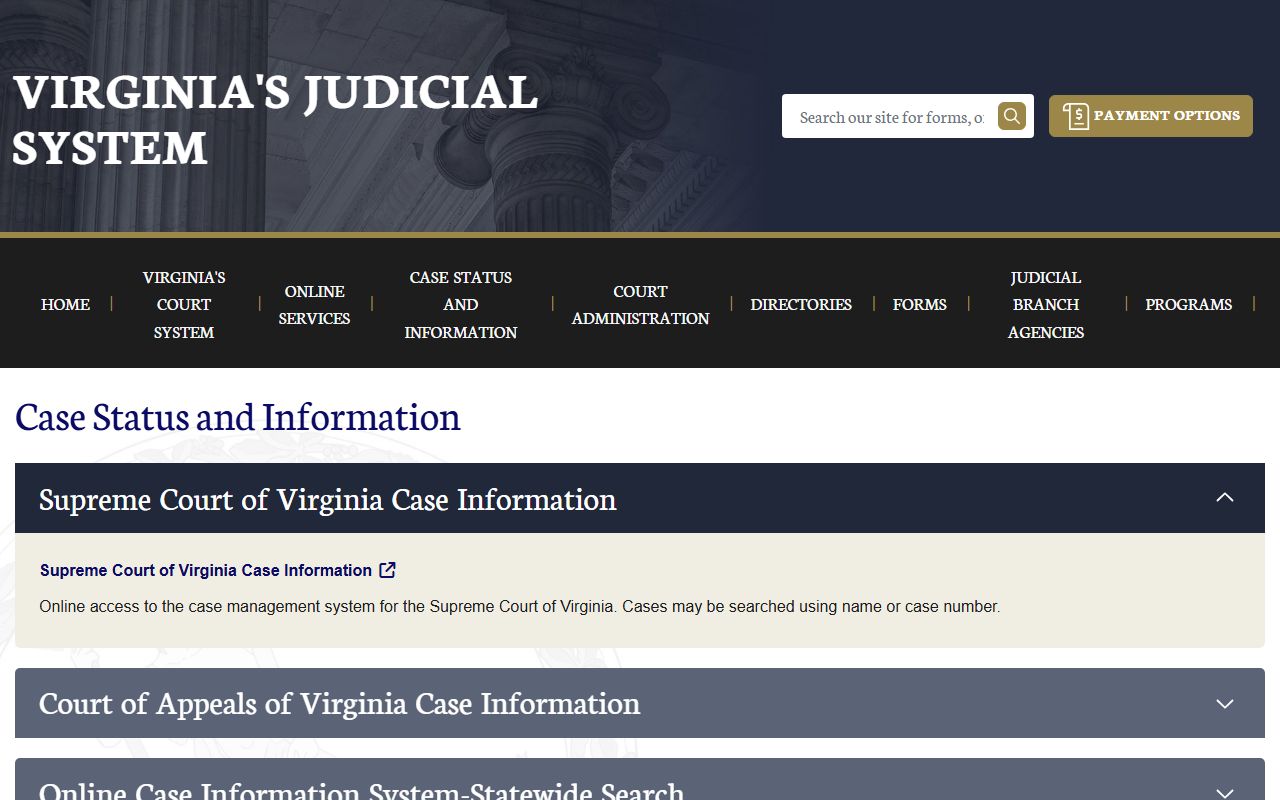
Use the court hub to choose the correct system before assuming that a jail booking charge and a filed court charge are the same record.
Giles County Court Search Fields
The court search fields are simpler than a jail lookup, but choosing the right court level is the key step. A name search may find active cases when a case number is not known. A case-number search is more precise. A hearing-date search can help when spelling is uncertain or when several people share a name.
| Field Label | Type | Required | Options / Format Notes |
|---|---|---|---|
| Court/locality | Dropdown | Yes | Select Giles County court or use statewide OCIS where available. |
| Name | Text | One search option | Use defendant or party name. Try spelling variants if results are thin. |
| Case number | Text | One search option | Use the exact case number from a summons, warrant, docket, or clerk notice. |
| Hearing date | Date | One search option | Helpful when a name search returns too many or too few results. |
| Court level | Portal/link choice | Yes | Choose General District, Circuit, or Juvenile and Domestic Relations based on the case. |
Charging Documents After Arrest
A charging document is the written paper that states the accusation in court. The label can vary by charge type and stage, but the function is the same: it tells the court and defendant what conduct is being prosecuted. Booking paperwork can help identify the arrest event, yet the court file controls what charges are formally before the judge.
| Document | Who Uses It | Common Stage | What to Check |
|---|---|---|---|
| Complaint or warrant | Law enforcement, magistrate, or prosecutor | Initial criminal accusation | Name, charge text, offense date, warrant or case number. |
| Information | Prosecutor | Formal charge route when allowed by law | Whether the filed charge differs from the booking accusation. |
| Indictment | Grand jury and prosecutor | Circuit Court felony stage | Felony count, code section, and whether earlier charges were replaced. |
For Giles County court records after an arrest, do not stop at the first charge seen on a jail entry. Prosecutors may amend, reduce, dismiss, nolle prosequi, or indict different charges as the case develops. Court records should be read by charge and by event date, not just by the first case title in the search results.
Giles County Charge Status
Charge status is the part of a court record that shows where the accusation stands. A pending charge is not a conviction. A dismissed charge is not the same as an expunged record. A nolle prosequi entry means the prosecutor declined to proceed on that charge at that time. If several charges appear in one case, each one can have a different result.
| Status | What It Means | Why It Matters |
|---|---|---|
| Pending | The charge has not reached a final disposition. | Check the next hearing date and bond conditions. |
| Amended | The charge text, code, or count changed. | The final case may not match the jail booking charge. |
| Reduced | The charge moved to a lower offense level or lesser count. | Compare the original charge with the final disposition. |
| Dismissed | The court ended the charge without a conviction. | The record may still appear unless sealed or expunged. |
| Nolle prosequi | The prosecutor declined to continue with the charge. | It is not a guilty finding, but the public record may remain. |
| Convicted | The defendant was found guilty or entered a guilty plea. | Review sentence, fines, probation, and appeal entries. |
Bond After Giles County Arrest
Bond records sit between jail custody and court case records. The NRVRJ bonding page explains that a defendant is brought before a magistrate after an arrest warrant for a criminal-law violation, and the magistrate may set release terms. A court can later change those terms. Because NRVRJ houses people for several jurisdictions, the controlling bond amount and conditions come from the magistrate or court paperwork, not from a general web search.
| Bond Type | How It Works | Record Check |
|---|---|---|
| Recognizance | Release based on a promise to appear and obey conditions. | Confirm the next court date and any special terms. |
| Unsecured bond | No upfront cash is paid, but money may be owed after noncompliance. | Read all court conditions before assuming release is automatic. |
| Secured or cash bond | Money or approved security must be posted before release. | Call NRVRJ or the court before traveling to post funds. |
| Surety bond | A bondsman or approved surety posts bond for the defendant. | A bondsman fee is not the same as a refundable court bond. |
| No bond or hold | Release is unavailable, or another agency has lodged a detainer. | Other county, probation, parole, federal, ICE, or Virginia Department of Corrections (VADOC) holds can block release. |
NRVRJ says current bonding questions should be confirmed with the jail before travel. The official jail bonding resource is the New River Valley Regional Jail bonding page. Court case searches help show whether a bond decision is tied to a filed charge, a failure to appear, a probation matter, or a warrant from another jurisdiction.
Giles County Warrants and Arrest
No official Giles County online active-warrant list was located in the research source set. That means a court-record search is useful, but it is not a complete warrant clearance. A bench warrant or capias may appear as a case event after a missed court date. An arrest warrant may lead to booking at NRVRJ and then a new court case. A search warrant is different because it authorizes a search of a place or property, not an inmate booking.
For general warrant or legal-process questions, the research points to the Giles County Sheriff's Office non-emergency number, 540-921-3842. General District Court can answer misdemeanor and preliminary-hearing case questions, while the Circuit Court Clerk can answer felony circuit record questions. Anyone who may have an active warrant should contact an attorney, the court, or the sheriff for instructions instead of relying on a web search alone.
Charges vs Convictions
A charge is an accusation. A conviction is a final guilty result by plea or adjudication. Giles County court records after a jail arrest may show both, but they should never be treated as the same thing. The charge list can change before the case ends, and one case can include charges with different outcomes.
| Point | Charge | Conviction |
|---|---|---|
| Meaning | An allegation filed or continued in court. | A formal guilty finding or guilty plea. |
| Timing | Appears early and may be amended. | Appears after final disposition on that count. |
| Proof level | May be based on probable cause at an early stage. | Requires the criminal standard for guilt. |
| Record use | Must be described as pending or unresolved unless disposed. | Can affect sentence, probation, fines, and later records. |
Sealed vs Expunged Records
Virginia public access rules allow many court and law-enforcement records to be inspected, but they also recognize limits. Virginia Code § 2.2-3704 sets the general FOIA process for existing public records. Virginia Code § 2.2-3706 governs law-enforcement and criminal records. Virginia Code § 19.2-392.2 provides expungement routes for certain police and court records.
| Point | Sealed or Restricted | Expunged |
|---|---|---|
| Public view | Hidden or limited for public users. | Removed from ordinary public access under a court order. |
| Common trigger | Juvenile status, protected information, or court restriction. | Eligible dismissed or otherwise qualifying police and court records. |
| Agency access | Some official access may remain. | Access is controlled by the expungement order and state law. |
| Reader action | Ask the clerk what can be released. | Review the statute and file through the proper court process. |
Virginia Code § 2.2-3706.1 also matters because criminal incident information and criminal investigative files are not the same as court case records. Juvenile matters, sealed files, victim or witness details, medical information, security-sensitive jail material, and active investigative content may be withheld or redacted.
Record Checks and Limits
Casual court lookup is not the same as a regulated background check. A court search may help confirm a case number, charge status, or hearing date, but it may not show every record that a legally compliant employment, housing, credit, insurance, or licensing screen would require. It also may show old or partial information if the user chooses the wrong court level or stops before checking Circuit Court.
Important: Court lookup results should not be used for FCRA-covered decisions such as employment, housing, credit, or insurance screening.